


Tips for Resizing Patterns: Including Mia to Clarisse Bag Pattern Hack
Have you ever finished sewing a bag and thought, “I love this pattern… but I wish it were just a little bigger?”
Learning how to resize a bag sewing pattern is one of the most valuable skills a bag maker can develop. Once you understand how to scale pattern pieces while maintaining proportion, you can transform almost any bag into the perfect size for your needs.
In fact, that’s exactly what inspired the Clarisse—which is the upsized version of our popular Mia Crossbody Bag Pattern. Our sewing community loved the simple design of the Mia, and many sewists asked for a larger version that could hold more everyday essentials.
To help demonstrate the process, we’ve partnered with Missouri Star Quilt Company to share tips for upsizing sewing patterns in a video tutorial.
In this guide, we’ll walk through practical techniques for resizing bag patterns while keeping the design balanced and professional.
And if you still have questions, we’ve included a Frequently Asked Questions section at the end of this article with answers to some of the most common questions sewists have about resizing bag patterns.
Watch the Video: How We Upsized the Mia Bag
In our collaboration with Missouri Star Quilt Company, we demonstrate how the Mia bag can be scaled into a larger version while preserving its signature shape.
This tutorial shares practical tips for upsizing sewing patterns, including how proportion, hardware choices, and strap options can change when a bag grows in size.
If you prefer written guidance, the tips below will help you confidently modify many bag sewing patterns!
Start by Thinking About Proportion
When resizing a bag sewing pattern, the most important consideration is proportion.
If the body of the bag becomes larger but the straps, hardware, or pockets stay the same size, the design can quickly feel unbalanced.
Before resizing pattern pieces, ask yourself:
Should the strap width increase to support a heavier bag?
Will the zipper length change?
Should pockets be larger or deeper?
Will hardware look too small on a larger bag?
A helpful rule of thumb is that structural elements should grow along with the bag. Maintaining these proportions ensures the finished design still looks polished.

Method 1: Print Pattern Pieces Larger
If your pattern includes printable templates, one of the easiest ways to make a bag pattern bigger is to print the pattern pieces at a larger percentage.
For example, you may print pattern pieces at:
125%
150%
175%
200%
After printing, measure one of the pieces to confirm the new scale.
Keep in mind that some patterns include pieces listed only as cutting dimensions instead of templates. Those measurements will need to be recalculated separately.

Method 2: Use Grid Paper to Redraw Pattern Pieces
Another reliable method for resizing sewing patterns is transferring the pattern pieces onto grid paper.
To make this process easier, we’ve created a free printable grid paper download you can use for your projects!
This technique works especially well for curved shapes.
Here’s how it works:
Draw the original pattern piece onto a small grid.
Redraw the same shape on a larger grid.
Each square represents the same point on the pattern.
This method gives you more control than simply enlarging a printed pattern, and it helps preserve the shape and structure of the original design while allowing you to scale it up or down.

Method 3: Recalculate Rotary-Cut Pieces
Many bag patterns include pieces that are measured and cut directly with a ruler and rotary cutter, rather than printed templates.
To resize these pieces, you can simply recalculate the cutting dimensions proportionally.
Start by deciding how much larger you want the bag to be.
For example:
Increase dimensions by 25% or 50% for a moderate size increase
Double the measurements if you want to significantly enlarge the design

Once you determine your scaling percentage, multiply both the length and width of each piece by the same amount.
However, not every measurement will necessarily change. Some pieces may remain the same size depending on the hardware used.
For example:
Zipper tabs may stay the same size if the zipper size doesn’t change
Strap connectors may only change if you increase hardware width
Strap lengths might stay the same depending on how the bag will be worn
Pockets may only change if you think an increase will be useful
Working through the measurements on paper first helps ensure all pieces stay proportional before cutting fabric.

Trace the Pattern Before Making Changes
Whenever you plan to modify a pattern, it’s best to trace the original pieces first.
Using pattern tracing material allows you to:
Experiment with sizing adjustments
Sketch pocket placements
Adjust closure options
Test handle placements
Some sewists even tape the traced pieces together to visualize the new size before cutting fabric. This simple step can prevent a lot of guesswork!

Adjust Hardware When Upsizing a Bag Pattern
When a bag becomes larger, the hardware may also need to change.
Consider whether you should increase:
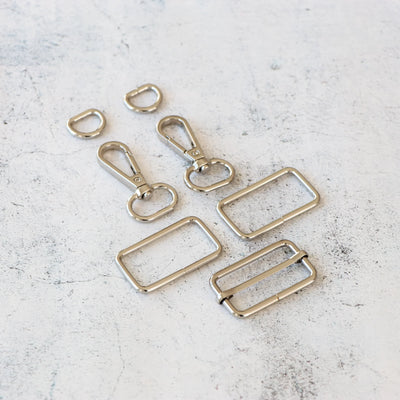
Strap connector width
Sometimes the original hardware still works perfectly. Other times, larger hardware improves both the strength and visual balance of the bag.
For example, when converting a crossbody bag into a handbag or tote, you might switch to metal strap connectors similar to those used in the Daphne Bag Pattern. These connectors instantly elevate the design and provide strong support for larger bags.

Explore New Handle Options
Resizing a bag pattern is also a great opportunity to experiment with different handle styles.
Instead of using the original strap design, you might choose:
Shoulder straps
Structured top handles
Short handbag handles
One of our favorite options is the DIY Bag Handles Pattern, which allows you to create custom handles designed specifically for your bag size.
This free pattern includes:
Three handle shapes
Two assembly options
Hardware options for decorative accents
For a more elevated, ready-to-install option, consider incorporating metal handles or strap connectors. Hardware instantly changes the look and feel of your bag—from handmade to high-end.
A standout choice is our textured loop strap connectors, which add both visual interest and a secure attachment point for straps or handles. They’re especially effective when you want a clean, professional finish without bulky seams.
These options pair beautifully with materials like:
They provide the structure and durability needed for handles, while still being approachable on a home sewing machine. Custom handles are a wonderful way to make your resized bag feel intentional and uniquely yours!
Try Quilted Techniques for a Fresh Look
Miranda ToteIf you’re looking for another way to elevate your resized bag, incorporating quilted elements is a beautiful option.
Quilted bags are having a major moment in fashion, blending timeless craftsmanship with modern structure. Adding quilted panels or patchwork details can completely transform the look of your bag—especially when working with larger surfaces after upsizing a pattern.
We recently partnered with Missouri Star Quilt Company to explore how quilting techniques can be adapted for bag making. In this video series, we walk through three projects—Miranda, Mia, and Charade—showing how to turn classic quilt blocks into functional, everyday bags.
These projects are a great example of how quilting and bag making come together:
Miranda Tote introduces simple quilted panels with practical storage
Mia Crossbody uses string quilting techniques—perfect for scraps and precuts
Charade Bag features patchwork construction with precise piecing

Quilted techniques work especially well when resizing a pattern because they allow you to:
Add structure without heavy interfacing
Showcase multiple fabrics or scraps
Create visual interest across larger panels
If you’ve never combined quilting with bag making, this is a great place to start. It’s a creative way to expand your skills while designing a bag that feels both classic and current.


Plan Interior Storage for Larger Bags
As a bag gets larger, empty space becomes more noticeable.
Upsizing a pattern is the perfect time to consider adding:
Interior slip pockets
Zipper pockets
Organizational dividers
A padded slip pocket to use as a laptop sleeve
Tracing the lining pieces first allows you to sketch pocket placement before cutting fabric.
This helps you design the interior layout with the same care as the exterior.

Reevaluate the Closure
Closures often need to change when resizing a bag pattern.
Depending on the new size, you may want to adjust:
Flap closures
Drawing seam allowances onto your traced pattern pieces can help determine whether your closure will still fit correctly.

One of the most helpful habits when modifying sewing patterns is creating a test sample.
Use scrap fabric or a second-choice fabric to test:
Hardware placement
Strap length
Pocket size
Overall scale
Making a test version allows you to refine the design before cutting into your favorite fabrics.
Even experienced pattern designers rely on this step—it’s simply part of the process.

Final Thoughts
Resizing a bag sewing pattern may seem intimidating at first, but with a few thoughtful adjustments, you can confidently customize patterns to suit your needs.
Whether you’re enlarging a crossbody bag into a roomy everyday tote or experimenting with new handle styles, understanding how scale affects straps, hardware, and pockets allows you to adapt patterns while preserving their original design.
The Clarisse bag grew directly from this creative process—and it’s a wonderful example of how sewists’ ideas can inspire new designs!
With a little planning and experimentation, you can transform your favorite patterns and Create Confidently!

Can you resize any sewing pattern?
Many sewing patterns can be resized, especially bag patterns that use simple shapes and rectangular pieces. By increasing or decreasing pattern pieces proportionally, sewists can adjust the overall size of a bag while maintaining its design. When resizing a bag pattern, it’s important to also evaluate hardware size, zipper length, strap width, and pocket placement so the finished bag remains functional and well balanced.
Can you resize a bag sewing pattern larger?
Yes. Many bag sewing patterns can be upsized by increasing pattern pieces proportionally and adjusting elements such as straps, hardware, and closures to maintain balance.
How do you make a bag pattern bigger?
You can enlarge a pattern by printing pattern pieces at a larger percentage, redrawing pieces using grid paper, or proportionally increasing cutting dimensions.
Do you need larger hardware when upsizing a bag?
Often, yes. Larger bags typically require wider straps, stronger connectors, and longer zippers to maintain structure and durability.



Leave a comment